A driveway in Greer is only as good as the stone under it
Most of the cracked driveways we replace were poured on bare clay or loose fill by someone in a hurry. Ours start with a shovel, not a form: the bed is dug to firm ground, built back up with compacted crushed stone, and only then poured, reinforced and jointed so the slab moves where we tell it to.
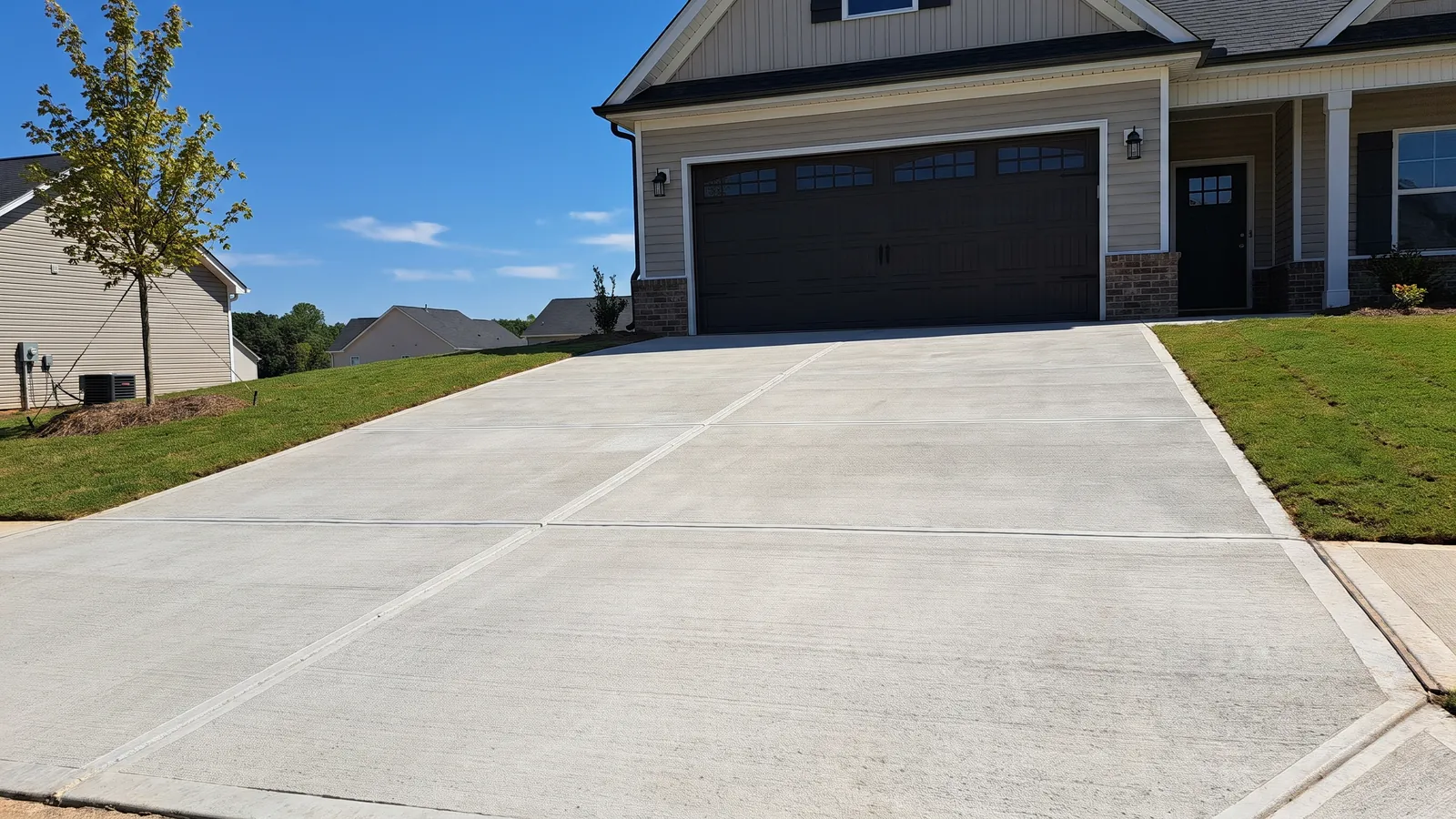
A concrete driveway in the Upstate is asked to do something a driveway in Charleston is not: sit on a clay that swells and shrinks with every wet spring and dry August, carry the trucks that come with a growing subdivision, and survive forty-odd freezes a winter without shedding its surface. The concrete itself is the easy part. What separates a driveway that is still clean at twenty years from one that is a patchwork at five is what happens before the truck arrives.
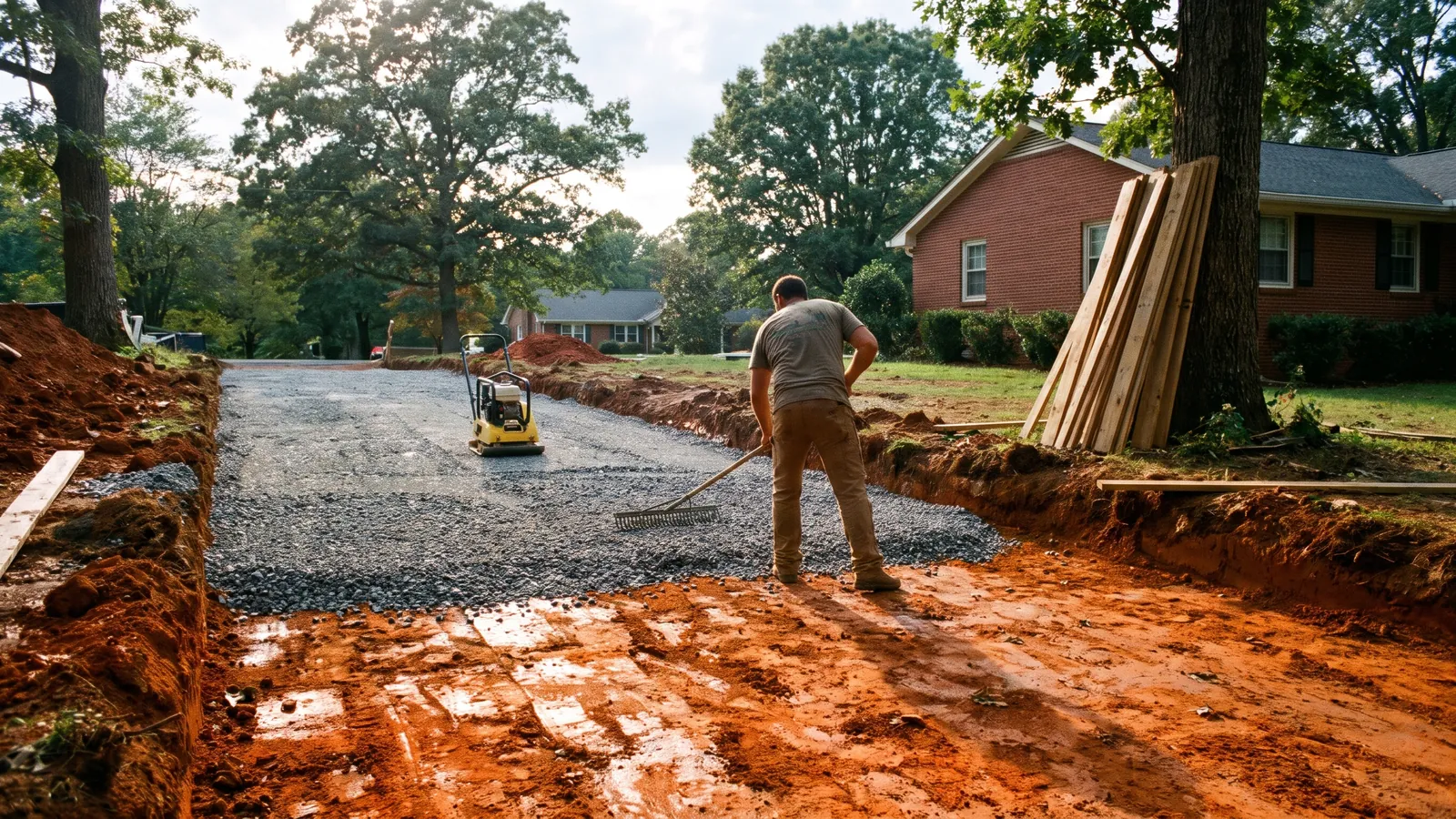
Here is what that looks like on our jobs. The old driveway, if there is one, is broken out and hauled off. The bed is excavated past the topsoil and any loose fill until the probe hits firm, undisturbed clay; on the newer lots off Highway 14 and along I-85 that can be deeper than the builder's driveway ever went, because the lot was graded with fill that has not finished settling. Four to six inches of crushed stone go in, compacted in lifts with a plate compactor or roller, and the forms are set with a fall of at least a quarter inch per foot away from the garage so water never sits against the house. Reinforcement is either welded wire mesh lifted into the middle of the slab on chairs, rebar on a grid for a driveway that will see heavy trucks, or a fiber-reinforced mix where that suits the job better; the estimator will say which and why.
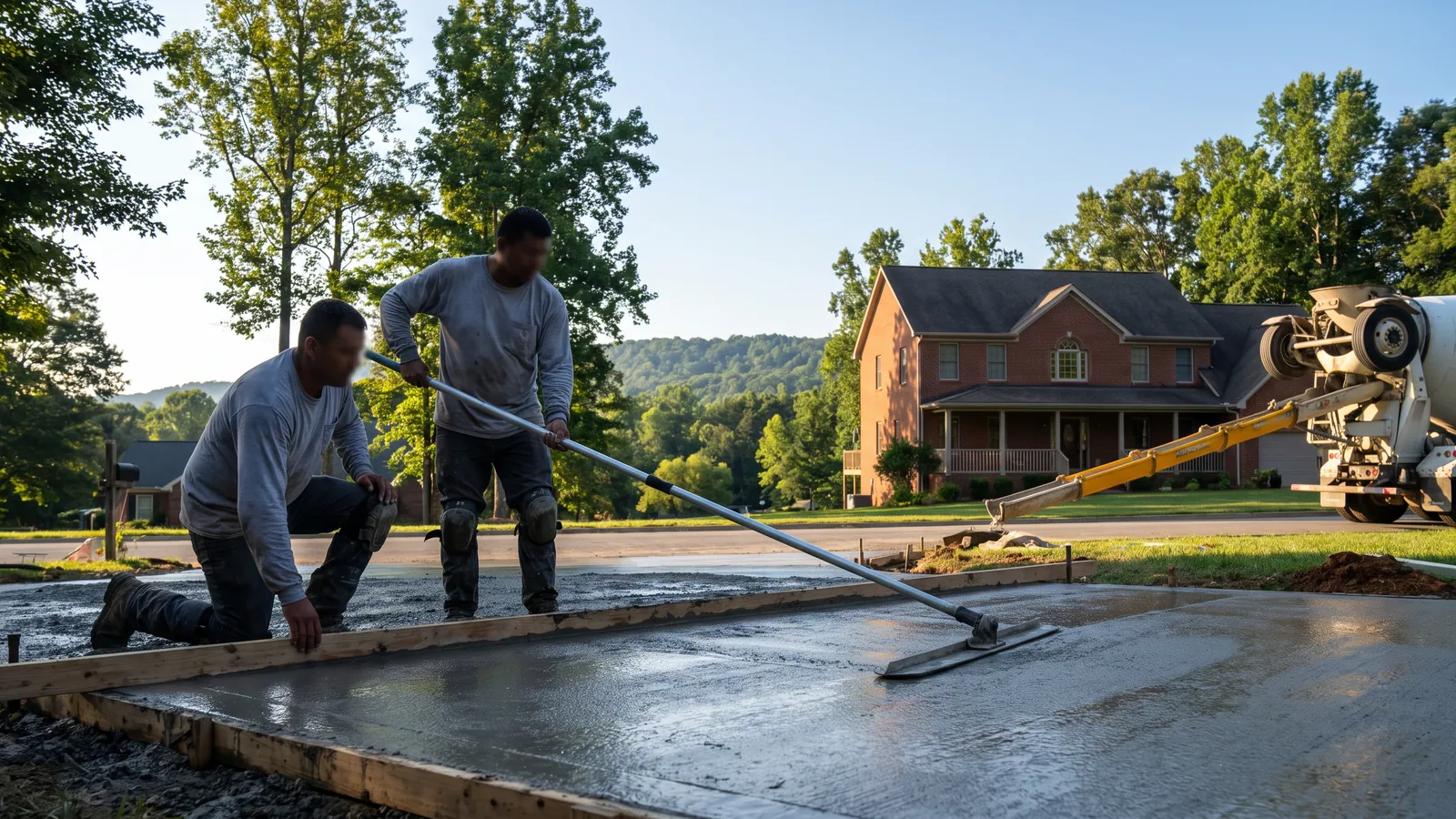
The pour is scheduled for the hour the weather allows: early morning from May through September so the surface does not dry out ahead of the core, and inside a frost-free window in winter. A standard driveway is four inches thick with a broom finish for grip, and the control joints are cut with a saw the same day, at a spacing of roughly two to three feet for every inch of thickness, so that the shrinkage cracks every slab gets happen inside the joints where nobody sees them. A stamped, colored or exposed-aggregate driveway follows the same base and reinforcement with a different last day. The slab is then cured, not simply left to dry, and you get a plain timeline for walking on it, parking on it and, a month or so later, sealing it.
We also widen and extend driveways for a third car or a turnaround, pour aprons and the strip between the street and the slab, and replace the section at the garage door that has dropped and left a lip. Driveway replacement in Greer, Greenville County and Spartanburg County normally needs no building permit, though a new curb cut or apron on a public street can involve the city or the county, and the estimator checks that before pricing.
What the job includes
Dug to firm ground
Topsoil and loose fill removed until the probe meets stable, undisturbed clay; the depth is what it needs to be, not what the forms happen to allow.
Compacted stone base
Four to six inches of crushed stone placed in lifts and compacted, the single biggest reason a driveway here lasts.
Graded to drain
Forms set with a positive fall away from the house and toward the street or a drain, checked with a level before the pour, not after.
Reinforced for the load
Wire mesh on chairs, rebar on a grid, or fiber mix, chosen for the weight the driveway will carry and written on the estimate.
Jointed on time
Control joints saw-cut the day of the pour at the right spacing and depth, so cracking happens where it is meant to.
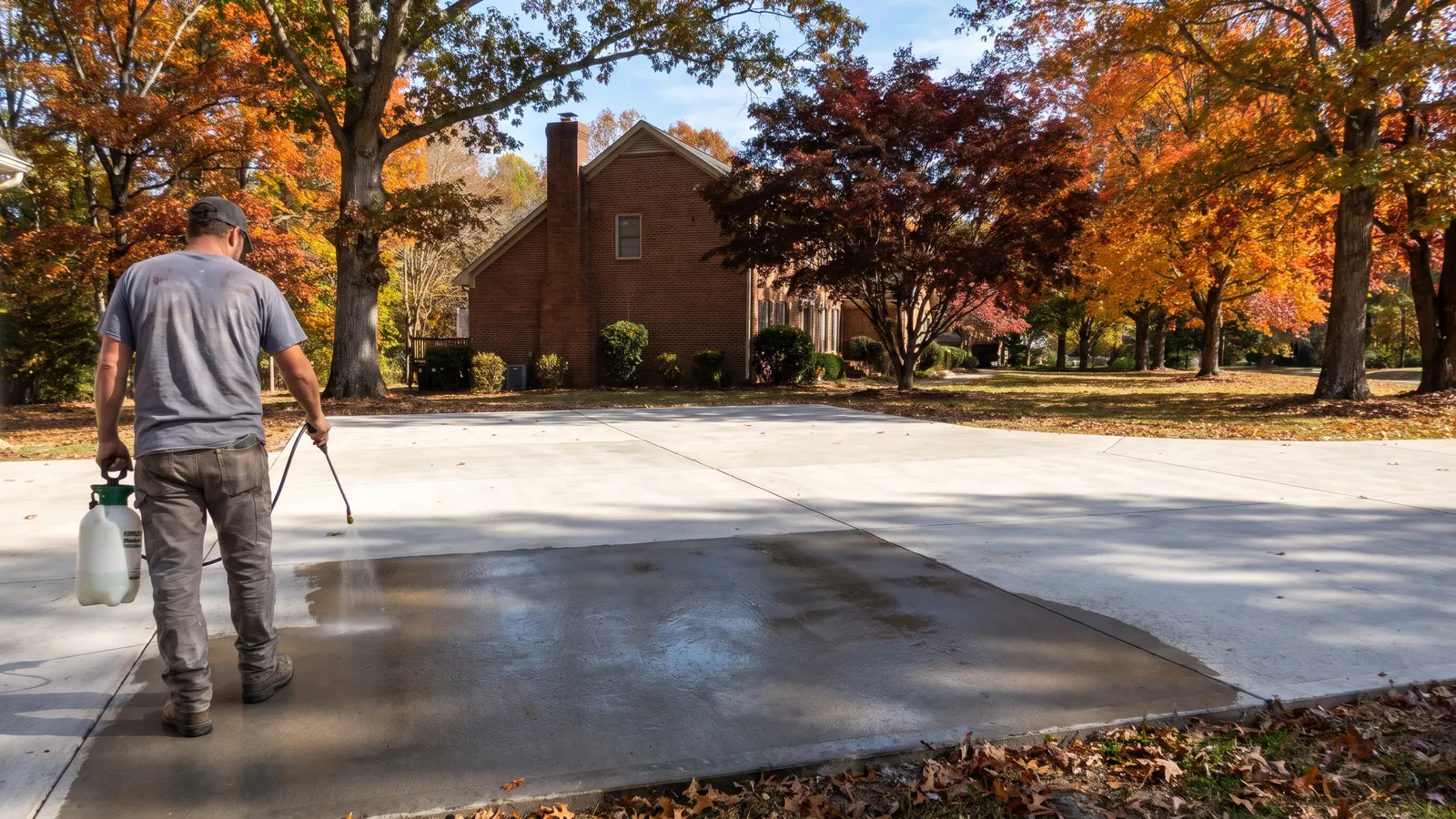
Cured and sealed
Wet curing or curing compound, a clear timeline for use, and penetrating sealer once the slab has cured out.
Concrete driveways prices in Greer, SC
| Work | 2026 range | What changes it |
|---|---|---|
| Broom-finish driveway, 4 in, per sq ft | $6 – $16 | Base depth, access and reinforcement move it most |
| Two-car driveway, about 800 sq ft | $4,800 – $12,800 | At the per-square-foot range above; removal of the old slab is its own line |
| Thicker slab (5–6 in) for trucks or RVs | Added per sq ft | Priced on the estimate with heavier reinforcement |
| Stamped or colored driveway, per sq ft | $12 – $25 | See decorative concrete |
| Exposed aggregate finish, per sq ft | $8 – $18 | Within the colored-concrete range |
| Driveway extension or turnaround | Per sq ft as above | Tied to the existing slab with dowels |
| Sealing a new driveway, per sq ft | $1.50 – $4 | Best done about a month after the pour |
Budgeting ranges for the Upstate in 2026, drawn from current contractor cost guides. Your figure is written after the estimator has measured the site and checked the ground, and it is itemized so you can see where the money goes.
On site
Concrete driveways questions, answered
How thick should a residential driveway be?
Four inches of concrete over four to six inches of compacted stone for cars and pickups. Go to five or six inches with rebar where an RV, a boat trailer or regular delivery trucks will sit. Thickness without a good base is wasted money; a thin slab on a solid base outlasts a thick slab on clay.
Why did my builder's driveway crack so fast?
Most production driveways are poured on the graded lot with little or no stone and the joints cut late or too shallow. On freshly filled Piedmont clay that is a recipe for cracks by year three or four. A replacement poured on compacted stone with joints cut on the day does not have that problem.
When can I drive on it?
Walk on it after a day, park a car on it after about a week, and keep heavy trucks off for a month. Concrete keeps gaining strength for weeks; the timeline on the estimate is written for the mix and the season.
Do I need a permit?
For a residential driveway replacement in Greer, Greenville County or Spartanburg County, generally no. A new apron or curb cut onto a public road can involve the city or county, and we check before pricing.
Can you match the old concrete's color on an extension?
Close, never exact. New concrete is lighter and darkens as it cures and weathers, and the old slab has years of staining. A saw-cut joint at the seam, or an extension that reads as its own panel, looks better than a fade line.
Should I seal a new driveway?
Yes, after about a month, with a penetrating silane or siloxane sealer, and again every two or three years. In a climate with 40 to 60 freeze-thaw days a year it is the single cheapest thing that extends a driveway's life.