Red clay and your concrete: why Upstate driveways crack, and how to build one that does not
Every lot in Greer sits on Piedmont red clay, and the clay, not the concrete, is why most driveways here fail. It swells when wet, shrinks when dry, drains badly and, on the new subdivisions, was pushed into place a few years ago and is still settling. Here is what it does to a slab and what a contractor has to do about it.
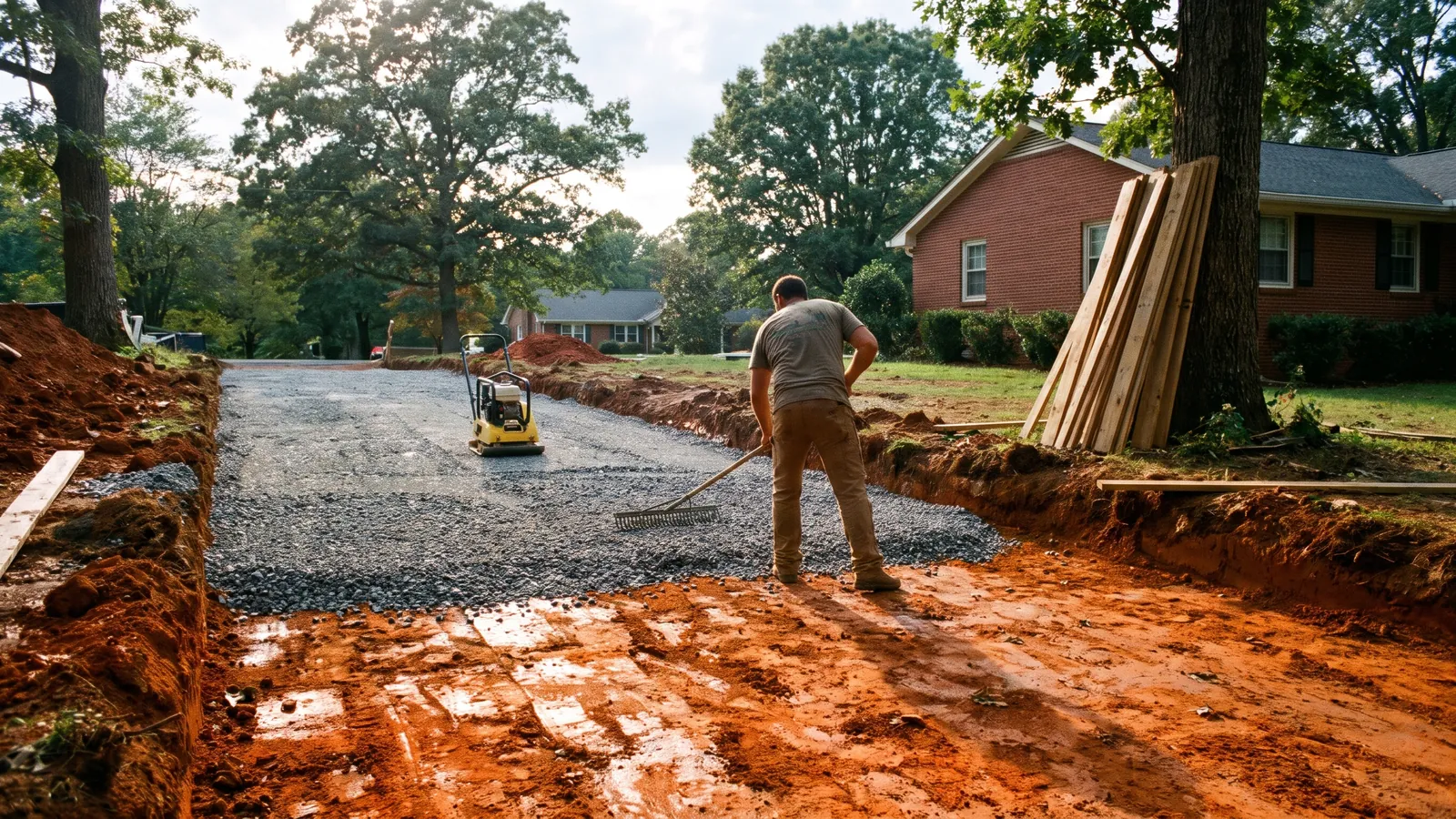
Dig anywhere in Greer, Taylors, Duncan or Simpsonville and a few inches below the topsoil you hit the orange-red clay that covers the Piedmont from the fall line to the Blue Ridge. It is the residual soil of weathered rock, it is everywhere in the Upstate, and it is the single most important thing to understand before pouring concrete on it. No directory listing and few contractors' websites say so, which is why so many Greer driveways look the way they do.
What the clay does
It swells and shrinks
Piedmont clay takes on water and expands, then dries and contracts. Greer gets about 49 inches of rain a year, most of it in the wet seasons, followed by hot, dry late summers, so the ground under a slab goes through that cycle every year. A slab poured directly on clay rides up and down with it, and because the movement is never even, the slab cracks. The cracks that widen and offset, with one side higher than the other, are this.
It does not drain
Clay holds water instead of letting it through. Rain that runs off a slab's edge or through an open joint sits on top of the clay underneath, softens it, and in winter freezes in it. A slab with no stone base is sitting on a sponge that turns to mud in spring and to ice in January.
Fill is worse than undisturbed clay
Greer has grown by about forty-one percent since 2020, and the new subdivisions along I-85, Highway 14, the Wade Hampton corridor and the Duncan and Lyman side were built by mass-grading rolling land and filling the low parts. Fill that was placed and compacted in lifts behaves. Fill that was pushed into place keeps consolidating for years, and clay fill does the shrink-swell cycle on top of that. The builder's driveway poured straight onto a filled lot is the slab that cracks by year three and drops at the garage by year five, and we replace a lot of them.
What proper preparation looks like
- Excavate to firm ground. Strip the topsoil and any loose fill until a probe meets stable, undisturbed clay. On a new lot that can be deeper than the builder's slab ever went.
- Compact what is left. Proof-roll the bed; cut out any soft spots and replace them with stone.
- Build a stone base. Four to six inches of crushed stone, placed in lifts and compacted after each one. The stone spreads the load, drains the water the clay will not, and gives the slab a stable, uniform bed.
- Grade to drain. Forms set so the slab falls away from the house and water leaves it at an edge or a drain, never into the base.
- Reinforce and joint. Mesh, rebar or fiber as the load requires, and control joints cut the day of the pour so the shrinkage every slab goes through happens inside the joints.
- Seal. About a month after the pour and every two or three years after, so water stays out of the slab and out of the base.
Questions to ask any contractor
What goes under the slab, and how deep? How is it compacted? Where does the water go? When are the joints cut? If the answers are vague, the price is probably low for a reason, and the driveway will tell you why in a few winters. A quote that is well under the ranges in our cost guide is usually a quote that skipped the base.
What this guide is not
This is a diagnostic explanation of why slabs move on clay, not a sales pitch for foundation work. If your house itself is settling, that is foundation repair, a separate engineered trade, and we will say so rather than attempt it. Driveways, patios, walks, steps and outbuilding slabs are what we pour, lift and repair.
Questions this guide gets asked
Is red clay a problem everywhere in South Carolina?
No, which is why advice written for the coast does not apply here. The Lowcountry is sand; the Upstate is Piedmont clay with freeze-thaw winters. Greer's concrete has to be built for Greer.
My builder's driveway cracked in three years. Why?
Almost certainly poured on graded fill with little or no stone base and joints cut late. The fill kept settling and the clay kept moving, and the slab went with it.
How deep does the stone base need to be?
Four to six inches of compacted crushed stone under residential flatwork, deeper where the probe finds soft fill. The depth is set on site.
Can an existing slab on clay be saved?
If it is intact and has only settled, it can be lifted. If it is cracked into pieces or heaving, it is replaced on a proper base. The repair-or-replace guide walks through the signs.
Does a stone base add much to the price?
It is a line on every estimate and a modest share of the total. Leaving it out is how a driveway ends up costing twice, once now and once in five years.
Do you fix settling houses?
No. Slab settlement on clay and foundation settlement are different problems; the second needs an engineer and a foundation specialist.
Read next: Concrete driveways · New-construction concrete · Freeze-thaw and sealing · Concrete leveling