Repair, level or replace? Reading the cracks in a Greer driveway
Three kinds of damage, three different answers, and the difference between them is worth thousands of dollars. Here is how to read your own driveway before anyone with a truck tells you what it needs.
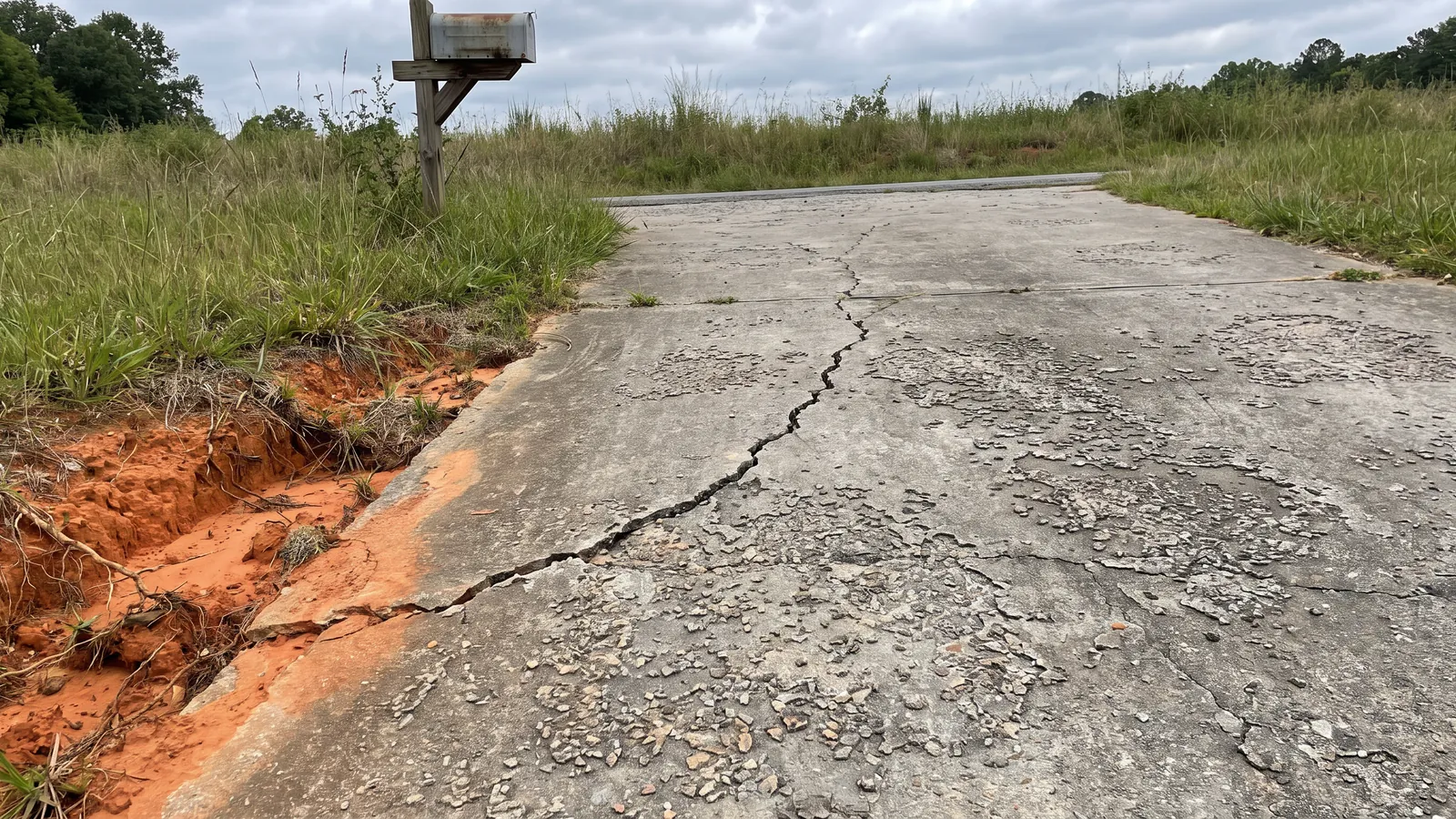
The estimator's first job on a repair call is not to measure; it is to decide which of three things the driveway needs. Repair fixes the surface. Leveling fixes a slab that dropped. Replacement fixes a base that has failed. Choose the wrong one and the fix fails within a season. The signs are readable without any tools, so here they are.
Signs that point to repair
- Flaking or scaling across the surface, with solid concrete underneath. Freeze-thaw damage on an unsealed slab, or water troweled into the finish. Fix: pressure clean, resurface with an overlay, seal.
- A web of fine, shallow cracks that have not widened. Hot-weather plastic shrinkage. Fix: seal, or overlay if the look bothers you.
- One or two long, narrow cracks the same width end to end, with the slab level on both sides. Shrinkage cracks the joints did not catch. Fix: route, fill with a flexible sealant, seal the slab.
- Chipped edges, spalled joints, a broken step nosing. Fix: bonded repair mortar formed to the profile, joints re-caulked.
Signs that point to leveling
- A lip where one slab meets the next, or at the garage floor, with both slabs intact.
- A walk or patio that tilts toward the house, or holds water where it used to drain.
- A dropped section near a downspout, a street edge or a patio edge where water has washed out the base.
In every one of these the concrete is fine and the ground under it moved. Foam or slurry under the slab lifts it back, usually in a morning, and the joints are sealed so water stays out of the base. See leveling.
Signs that point to replacement
- Cracks that are widening from season to season, or that run in a map pattern across the slab.
- Offset cracks, with one side higher than the other. The clay is moving under the slab.
- Heaving: sections pushed up rather than dropped.
- The slab is in many pieces, or you can hear it rock when a car drives on it.
- Visible wash-out: red clay or a void you can see under the edge of the slab, on a lot that is still settling.
An overlay on a moving slab cracks where the slab cracks. A lift on a slab in a dozen pieces does not lift evenly. The honest answer here is removal and a new slab on a compacted stone base, and on a lot that has finished settling it will last as long as the house.
What each costs in 2026
| Answer | 2026 range | Typical job |
|---|---|---|
| Crack filling and sealing | Priced on inspection + $1.50 – $4 / sq ft | A morning |
| Resurfacing overlay | $3 – $10 / sq ft | A day, then seal |
| Foam leveling | $5 – $15 / sq ft lifted | A morning, drive on it that day |
| Mudjacking | $3 – $8 / sq ft lifted | A morning, drive on it next day |
| Replacement on a new base | $6 – $16 / sq ft + removal | Two to three days, cure a week |
The one honest test
Ask whether the slab is still level and in one piece. If yes, the surface can be repaired or the slab can be lifted, and either costs a fraction of a replacement. If no, nothing applied to the top will hold, and the money is better spent on the base. The estimator comes to that call on the first visit, for free, and says it plainly either way.
Questions this guide gets asked
My driveway has one long crack. Is it serious?
If it is the same width end to end and the slab is level on both sides, it is a shrinkage crack: fill it, seal the slab and move on. If it is widening or offset, the base is moving and it is a replacement question.
The slab dropped at the garage but has no cracks. What now?
That is a leveling job. Foam lifts the slab back to the garage floor in a morning for a small fraction of a replacement.
Can you put a new surface over my old driveway?
Over a level, sound slab, yes, with an overlay. Over a cracked or moving slab, no; the overlay fails where the slab moves.
How do I know if the clay is still moving?
Cracks that get wider year to year, slabs that are higher on one side of a crack than the other, and lips that come back after a lift are the signs. Newer subdivisions on fill show them most.
Is replacement always the most expensive?
Usually, but a replacement done once on a proper base is cheaper than a repair every two years on a slab that was never going to hold. The estimate shows both numbers.
Do you charge to assess it?
No. The visit and the written answer are free, whichever of the three it turns out to be.
Read next: Concrete repair · Concrete leveling · Leveling and repair cost · Red clay and your concrete